
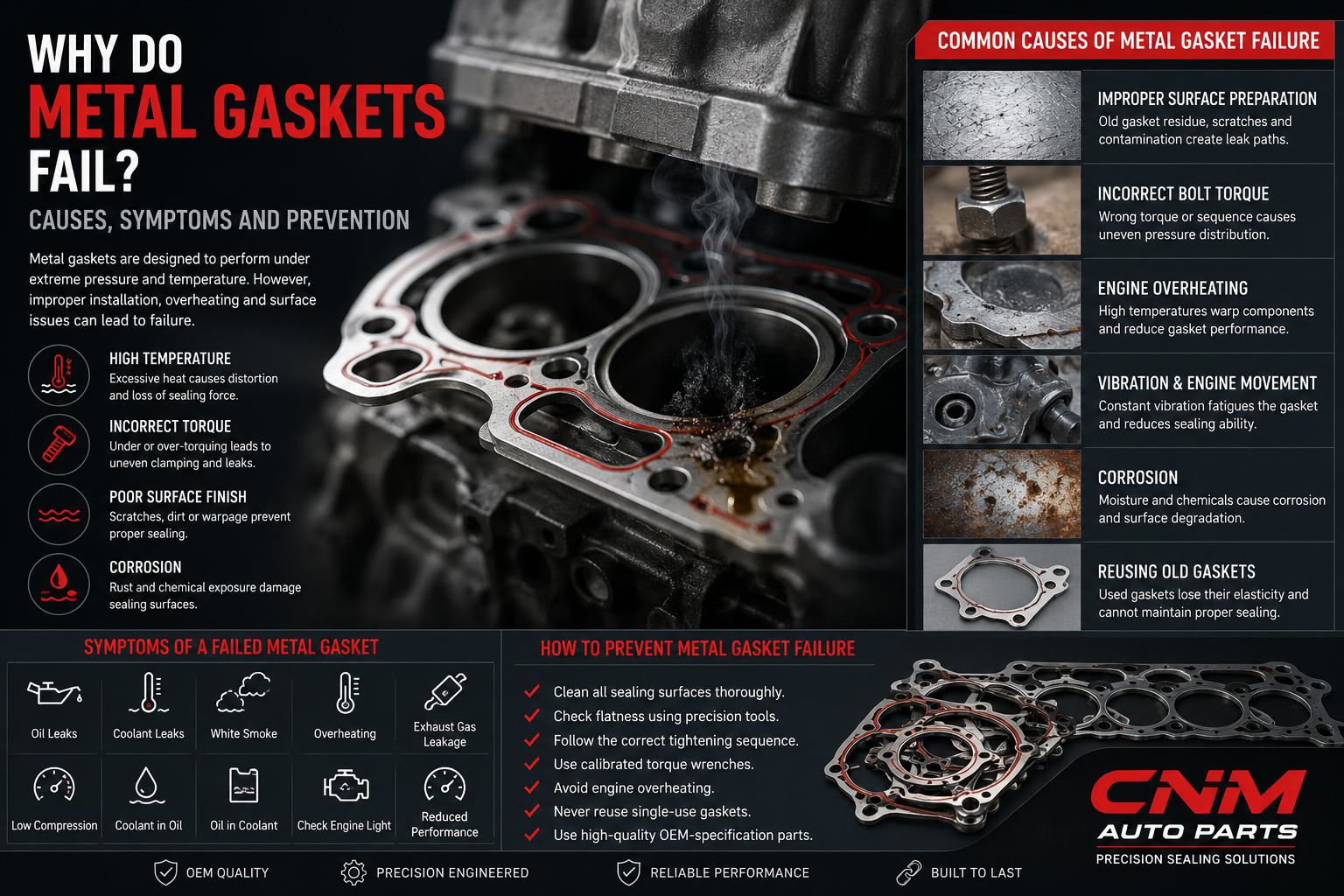
Metal gaskets are designed to provide a reliable seal between engine components operating under extreme pressure and temperature. They are commonly used in cylinder heads, exhaust manifolds, intake manifolds, oil coolers, timing covers and turbocharger assemblies because of their excellent durability and heat resistance.
Despite their strength, metal gaskets are not indestructible. Premature gasket failure is almost always the result of installation errors, poor surface preparation, excessive engine movement, overheating or improper operating conditions rather than the gasket itself.
Understanding why metal gaskets fail can help prevent expensive engine repairs and improve long-term reliability.
What Is a Metal Gasket?
A metal gasket is a sealing component manufactured from stainless steel, spring steel, coated steel or multiple layers of engineered metal. Unlike conventional paper or rubber gaskets, metal gaskets maintain their sealing performance under:
- High combustion pressure
- Extreme exhaust temperatures
- Thermal expansion
- Engine vibration
- Continuous mechanical load
Modern engines increasingly rely on metal gaskets because of stricter emissions requirements and higher operating temperatures.
The Most Common Causes of Metal Gasket Failure
1. Improper Surface Preparation
One of the leading causes of gasket failure is installing a new gasket onto damaged or contaminated sealing surfaces.
Common problems include:
- Old gasket residue
- Scratches
- Corrosion
- Warped mating surfaces
- Dirt or oil contamination
Even microscopic imperfections may create leakage paths once the engine reaches operating temperature.
Professional technicians always inspect sealing surfaces with a straight edge and clean them thoroughly before installation.
2. Incorrect Bolt Torque
Every gasket is engineered to operate within a specific clamping force.
If bolts are:
- Under-torqued
- Over-torqued
- Tightened in the wrong sequence
the gasket may not distribute pressure evenly.
Uneven clamping creates localized stress concentrations that eventually lead to oil leaks, coolant leaks or combustion gas leakage.
Always follow the manufacturer’s torque specifications and tightening sequence.
3. Engine Overheating
Excessive engine temperature is one of the most destructive conditions for any sealing system.
Repeated overheating causes:
- Thermal expansion
- Metal distortion
- Cylinder head warping
- Loss of sealing pressure
Even premium stainless-steel gaskets cannot compensate for warped engine components.
Before replacing a failed gasket, the root cause of overheating should always be identified and corrected.
4. Poor Surface Flatness
Cylinder heads, exhaust manifolds and oil coolers must remain within strict flatness tolerances.
If either sealing surface becomes warped:
- Contact pressure decreases
- Hot gases escape
- Oil begins leaking
- Coolant may enter the combustion chamber
Precision machining may be required before installing a new gasket.
5. Vibration and Engine Movement
Engines experience constant vibration throughout their service life.
Excessive movement caused by worn engine mounts or loose fasteners places additional stress on sealing surfaces.
Over time this cyclic loading can fatigue the gasket and reduce sealing performance.
6. Corrosion
Moisture, coolant contamination and chemical exposure may cause corrosion between mating components.
Corrosion creates uneven sealing surfaces that prevent proper gasket compression.
Regular coolant maintenance significantly reduces this risk.
7. Reusing Old Metal Gaskets
Many metal gaskets are designed as single-use components.
After being compressed once, their elastic recovery characteristics are permanently altered.
Reinstalling a used gasket greatly increases the risk of leakage.
Professional repair procedures always recommend installing a new gasket during reassembly.
Symptoms of a Failed Metal Gasket
Depending on its location, a failed metal gasket may cause:
- Oil leaks
- Coolant leaks
- Exhaust gas leakage
- White exhaust smoke
- Reduced engine performance
- Engine overheating
- Coolant contamination
- Burning oil smell
- Low compression
- Check Engine Light
Early diagnosis helps prevent more severe engine damage.
How to Prevent Metal Gasket Failure
Reliable sealing begins long before the gasket is installed.
Best practices include:
- Clean all sealing surfaces thoroughly.
- Check flatness using precision measuring tools.
- Replace damaged bolts where required.
- Follow the correct tightening sequence.
- Use calibrated torque wrenches.
- Avoid engine overheating.
- Never reuse single-use gaskets.
- Use high-quality OEM-specification replacement parts.
Preventive maintenance is always less expensive than repairing a failed engine.
Why Material Quality Matters
Not all metal gaskets are manufactured to the same standard.
High-quality gaskets typically feature:
- Precision laser-cut profiles
- Multi-layer stainless steel construction
- Heat-resistant protective coatings
- Consistent material thickness
- Accurate embossing geometry
- Excellent corrosion resistance
These characteristics improve sealing reliability and extend service life under demanding operating conditions.
Conclusion
Metal gasket failure is rarely caused by the gasket alone. Most failures result from improper installation, overheating, warped sealing surfaces or incorrect torque procedures.
Using high-quality components together with proper installation techniques significantly reduces the risk of oil leaks, coolant leaks and premature engine failures.
For professional repairs, always select precision-manufactured gaskets that meet or exceed OEM specifications. Investing in quality parts today helps avoid costly repairs tomorrow.
About CNM Auto Parts
At CNM Auto Parts, we design and manufacture precision-engineered sealing solutions for demanding automotive applications. Our product range includes oil cooler gaskets, intake and exhaust manifold gaskets, timing cover gaskets, turbocharger gasket sets and specialized repair kits developed to meet OEM-quality standards.
Our goal is simple: deliver durable sealing solutions engineered for long-term reliability and professional performance.