
Choosing the right head gasket is one of the most important decisions during an engine rebuild or repair. The head gasket must withstand extreme combustion pressure, high operating temperatures and continuous thermal expansion while maintaining a perfect seal between the engine block and cylinder head.
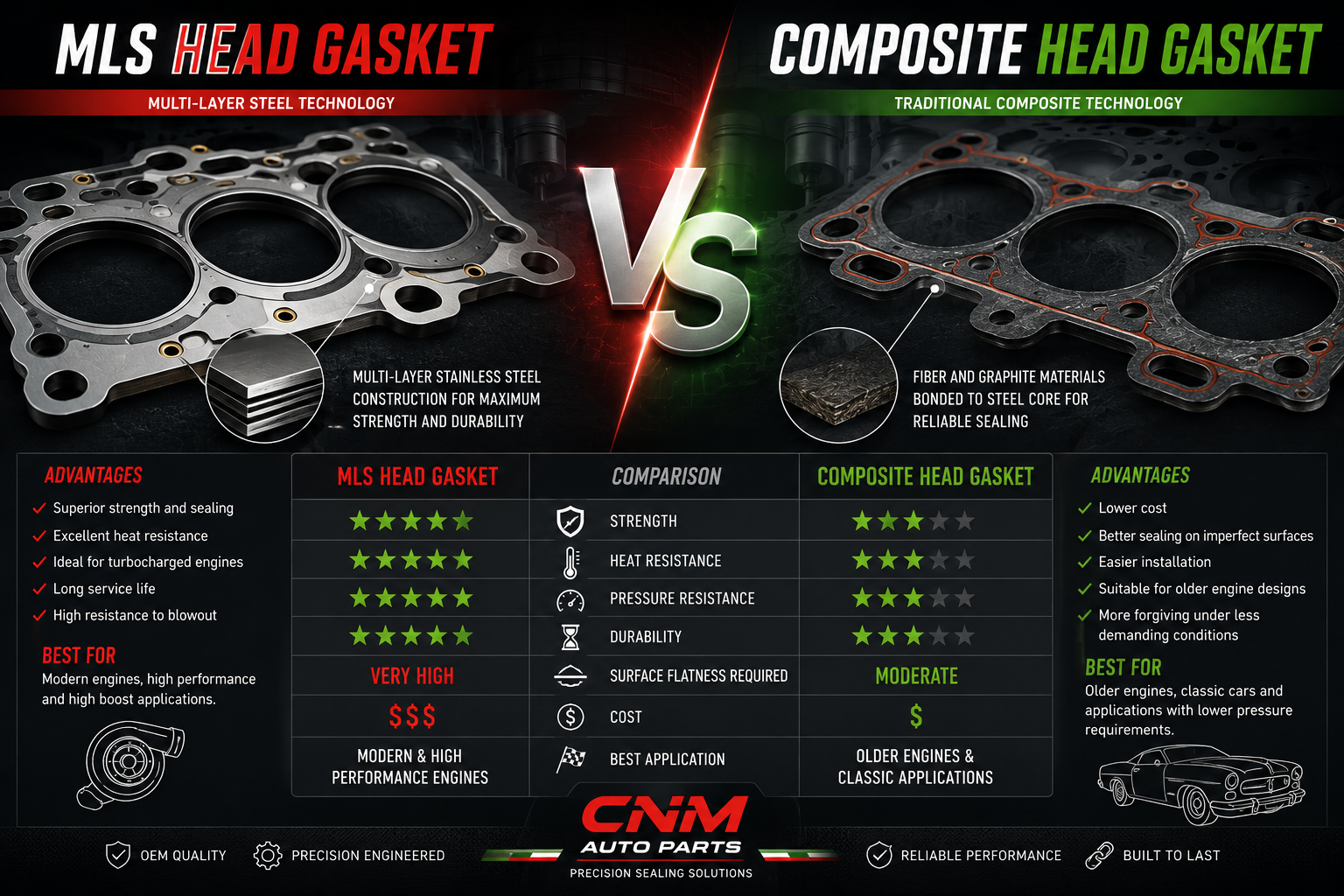
Today, two main types of head gaskets are commonly used in automotive engines:
- MLS (Multi-Layer Steel) Head Gaskets
- Composite Head Gaskets
Although both serve the same purpose, their construction, durability and ideal applications are very different.
This guide explains the differences between MLS and composite head gaskets, their advantages and disadvantages, and which type is best suited for your engine.
What Is an MLS Head Gasket?
An MLS (Multi-Layer Steel) head gasket consists of multiple thin layers of stainless steel bonded together. The outer layers are usually coated with heat-resistant elastomer materials that improve sealing performance.
Most modern gasoline and diesel engines use MLS gaskets because they provide excellent sealing under high combustion pressures.
Advantages of MLS Head Gaskets
- Excellent sealing under high cylinder pressure
- Outstanding resistance to heat cycles
- Long service life
- High durability
- Superior resistance to combustion gas leakage
- Ideal for turbocharged and high-performance engines
- Excellent resistance to engine vibration
Disadvantages
- Requires extremely flat sealing surfaces
- Installation is less forgiving
- Higher manufacturing cost
- Cannot compensate for warped cylinder heads
What Is a Composite Head Gasket?
Composite head gaskets are manufactured using graphite, fiber, aramid materials or other sealing compounds bonded to a steel core.
These gaskets were widely used in older engines and remain popular in many classic vehicles.
Advantages of Composite Gaskets
- Lower cost
- Better at sealing slightly imperfect surfaces
- Easier installation
- Suitable for older engine designs
- More forgiving on engines with minor wear
Disadvantages
- Lower heat resistance
- Reduced lifespan under severe operating conditions
- Less suitable for turbocharged engines
- More vulnerable to combustion pressure
- Higher risk of blowout during overheating
Construction Comparison
| Feature | MLS Head Gasket | Composite Gasket |
|---|---|---|
| Material | Multi-layer stainless steel | Fiber/graphite with steel core |
| Heat Resistance | Excellent | Good |
| Pressure Resistance | Excellent | Moderate |
| Durability | Excellent | Moderate |
| Surface Flatness Required | Very High | Moderate |
| Cost | Higher | Lower |
| Best for Modern Engines | Yes | Limited |
| Best for Older Engines | Sometimes | Yes |
Which Gasket Seals Better?
Under proper installation conditions, an MLS gasket provides significantly better sealing performance.
Its embossed stainless-steel layers maintain sealing pressure even during repeated thermal expansion and contraction.
However, this performance depends on perfectly machined sealing surfaces.
If the cylinder head or engine block is warped, an MLS gasket cannot compensate for the defect.
Which One Lasts Longer?
In normal operating conditions:
- MLS Head Gaskets often last the lifetime of the engine.
- Composite Gaskets generally have a shorter service life, especially in engines exposed to heavy loads or high temperatures.
Proper cooling system maintenance greatly influences gasket longevity regardless of material.
Which Is Better for Turbocharged Engines?
MLS head gaskets are the preferred choice for turbocharged and high-performance engines because they can withstand:
- Higher combustion pressure
- Increased cylinder temperatures
- Greater thermal cycling
- Higher boost pressure
For this reason, nearly all modern turbocharged manufacturers use MLS technology.
Surface Preparation Is Critical
Regardless of gasket type, successful installation depends on proper preparation.
Always:
- Clean both sealing surfaces thoroughly.
- Check cylinder head flatness.
- Inspect the engine block.
- Replace torque-to-yield bolts where required.
- Follow the manufacturer’s tightening sequence.
- Use a calibrated torque wrench.
Most gasket failures are caused by installation errors rather than defective parts.
Common Signs of Head Gasket Failure
Whether MLS or composite, a failed head gasket may produce:
- Engine overheating
- Coolant loss
- White exhaust smoke
- Oil and coolant mixing
- Low compression
- Combustion gas in the cooling system
- Reduced engine performance
- External oil leaks
Early diagnosis helps prevent extensive engine damage.
Which Head Gasket Should You Choose?
Choose an MLS Head Gasket if:
- Your engine originally used MLS technology.
- You own a modern gasoline or diesel engine.
- The engine has been professionally machined.
- The vehicle is turbocharged or high performance.
- Long-term reliability is your priority.
Choose a Composite Gasket if:
- You are restoring an older engine.
- The engine was originally designed for composite gaskets.
- Slight surface imperfections are unavoidable.
- Budget is an important consideration.
Using the gasket type specified by the engine manufacturer is generally the safest choice.
Conclusion
Both MLS and composite head gaskets have their place in automotive engineering.
MLS gaskets deliver superior strength, durability and sealing performance, making them the standard choice for modern engines operating under high pressure and temperature.
Composite gaskets remain a practical solution for many classic and older engines thanks to their flexibility and forgiving sealing characteristics.
Selecting the correct gasket, preparing the sealing surfaces properly and following the manufacturer’s installation procedures are the key factors in achieving a reliable, leak-free engine.
About CNM Auto Parts
CNM Auto Parts develops and supplies precision-engineered automotive sealing solutions for professional repair applications. Our product range includes oil cooler gaskets, manifold gaskets, timing cover gaskets and other OEM-quality sealing components designed for long-term reliability in demanding engine environments.